
PTSD vs CPTSD Key Differences in Trauma and Healing
- Aks Counselling And Psychotherapy
- Feb 13
- 16 min read
The biggest difference between PTSD and CPTSD comes down to the nature of the trauma itself. PTSD often grows out of a single, terrifying event, while CPTSD is usually the result of long-term, repeated trauma—especially in situations where it felt impossible to escape. Getting this distinction right is the first real step toward finding the right path to healing.
Understanding the Foundations of Traumatic Stress
Trying to make sense of trauma can feel overwhelming, but clarity is possible. While both Post-Traumatic Stress Disorder (PTSD) and Complex Post-Traumatic Stress Disorder (CPTSD) are serious responses to deeply distressing events, they aren’t the same thing. Recognizing what sets them apart is absolutely key to an effective recovery.
In Canada, the numbers show just how much trauma impacts our communities. Research shows that the lifetime prevalence of PTSD is around 9.2%, meaning roughly one in eleven Canadians will experience it. This makes sense when you learn that over 76% of us report being exposed to at least one traumatic event. It's a widespread experience.
This infographic helps simplify the core difference in the types of trauma that typically lead to PTSD versus CPTSD.
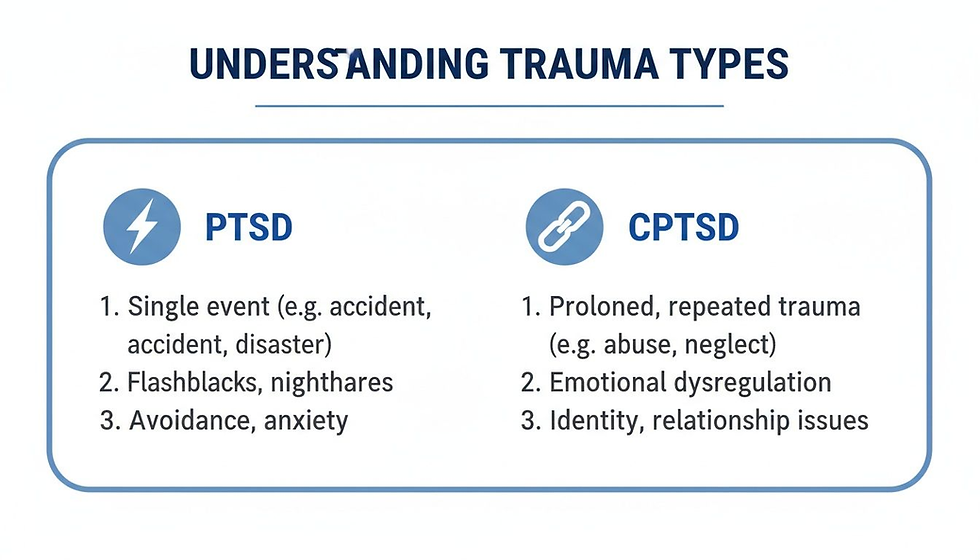
As you can see, PTSD is often tied to a distinct, high-impact incident. CPTSD, on the other hand, is connected to ongoing, cumulative stress that wears a person down over time.
PTSD vs CPTSD At a Glance Key Distinctions
While both conditions share core symptoms like flashbacks and avoidance, CPTSD brings extra layers of difficulty that stem from the chronic nature of the trauma. These added challenges can fundamentally change a person’s sense of self and their ability to connect with others. This is a crucial point that shapes the entire therapeutic approach.
The table below offers a high-level summary of these foundational differences. Understanding these distinctions can help you put your own experiences, or those of a loved one, into a clearer context.
Characteristic | PTSD (Post-Traumatic Stress Disorder) | CPTSD (Complex Post-Traumatic Stress Disorder) |
Nature of Trauma | Typically a single, short-term event (e.g., accident, assault, natural disaster). | Prolonged, repeated trauma, often relational (e.g., childhood abuse, domestic violence). |
Core Symptoms | Re-experiencing, avoidance, negative mood/thoughts, and hyperarousal. | Includes all PTSD symptoms plus additional disturbances. |
Emotional Impact | Fear, anxiety, and hypervigilance are primary. | Pervasive difficulties with emotional regulation, including intense anger or chronic sadness. |
Self-Perception | May feel guilt or blame related to the specific event. | Deep-seated feelings of worthlessness, shame, and a damaged sense of self. |
Relationships | Can cause detachment and difficulty in relationships. | Severe and persistent problems with trust, intimacy, and maintaining stable connections. |
Recognizing whether your experiences line up more with a single incident or a prolonged period of distress is an important insight. This knowledge can empower you to look for support that is specifically designed for your needs.
If you're new to the idea of professional support, you might find our guide on understanding the basics of psychotherapy a helpful starting point.
How Trauma Symptoms Show Up Differently
While PTSD and Complex PTSD (CPTSD) both stem from trauma, the way they impact a person's daily life can look worlds apart. You can think of PTSD as a mind and body stuck replaying a specific, terrifying event. CPTSD includes that replay, but it goes much deeper, fundamentally altering a person's sense of self and their ability to connect with others.
Getting a clear picture of these symptom clusters is the first step in understanding the true scope of what someone is going through.
The Four Core Symptoms of PTSD
The classic signs of PTSD are directly tied to the traumatic event itself. They represent the mind’s struggle to process something that felt overwhelming and life-threatening, like a serious accident or a violent assault. These symptoms disrupt a person’s fundamental sense of safety in the world.
Re-experiencing the Event: This isn't just remembering something bad. It’s having intrusive, unwanted memories that feel like they're happening all over again—vivid flashbacks during the day or terrifying nightmares at night.
Active Avoidance: A person might go to extreme lengths to stay away from anything that reminds them of the trauma. This could mean avoiding certain people, places, conversations, or even their own thoughts and feelings tied to the event.
Negative Shifts in Mood and Thinking: This often looks like persistent feelings of fear, guilt, anger, or shame. Someone might lose interest in things they once loved, feel disconnected from others, or develop a deeply pessimistic view of themselves and the world.
Persistent Hyperarousal: This is when the body's alarm system gets stuck in the "on" position. It can lead to being easily startled, feeling constantly on edge and watchful (hypervigilance), having trouble concentrating, or being unable to sleep.
For example, a veteran with PTSD might instinctively hit the ground when a car backfires because the sound triggers a flashback to combat. Their avoidance might look like refusing to go anywhere near fireworks displays, knowing the sounds and crowds will send their hyperarousal into overdrive.
The Added Layers of CPTSD
CPTSD is a different beast. It includes all the symptoms of PTSD but adds three more profound layers of difficulty. These additional struggles are a direct result of trauma that was prolonged and inescapable, like ongoing childhood abuse or long-term domestic violence.
Complex PTSD doesn’t just change how you remember a past event; it fundamentally reshapes your personality, your ability to manage emotions, and your capacity to form trusting relationships. It's an injury to the self, not just to memory.
These added symptom clusters are what truly set CPTSD apart.
Significant Challenges with Emotional Regulation: Survivors often grapple with intense, overwhelming emotions like explosive anger, persistent sadness, or suicidal thoughts. On the flip side, they may feel emotionally numb or completely disconnected from their feelings.
Profound Disturbances in Self-Concept: Chronic trauma can wire a person to believe they are worthless, powerless, or fundamentally broken. This often leads to pervasive feelings of shame, guilt, and a deep sense of being different from everyone else.
Severe Interpersonal Difficulties: Because the trauma was often inflicted by another person (like a caregiver or partner), the ability to trust is shattered. Survivors may struggle to build stable, healthy relationships, either avoiding intimacy completely or finding themselves in unhealthy dynamics that feel painfully familiar.
A key distinction between PTSD and CPTSD in a Canadian context comes from trauma exposure patterns. While 64.9% of adults report experiencing at least one event that could lead to PTSD, the types of trauma fuelling CPTSD are also disturbingly common. Women, for instance, disproportionately experience sexual assaults and unwanted sexual experiences. When these happen repeatedly over time, such as in childhood abuse or intimate partner violence, they become common pathways to CPTSD. You can explore more Canadian trauma exposure data on the government's public health site.
To see the difference clearly, picture an adult who survived years of childhood neglect. They might have PTSD symptoms like nightmares. But their CPTSD also shows up as a deep-seated belief that they are unworthy of love. This core belief makes it nearly impossible for them to trust a partner or accept affection, leading them to isolate themselves to avoid the rejection they feel is inevitable. This is a very different internal battle than the one fought by the veteran, whose primary struggle is managing triggers tied to a specific set of external events.
What Causes Traumatic Stress?
To really get the difference between PTSD and Complex PTSD, you have to look at where they come from. The kind of trauma someone goes through is often the biggest clue as to which condition might develop. While both are powerful, painful responses to being overwhelmed, their roots are very different.
Understanding these trauma patterns gives us critical context. It helps make sense of your own story and clarifies why you might be feeling the way you do.
The Foundation of PTSD: Single-Incident Trauma
PTSD is most often tied to what therapists call single-incident trauma. This means a specific, terrifying event that completely shatters a person's feeling of safety and predictability. The event usually has a clear beginning and end, but its psychological shockwaves can last for years.
These experiences are typically life-threatening, or at least feel that way, leaving a deep mark on the nervous system. The mind gets stuck on that one overwhelming moment or a very short period of time.
Common examples of traumas that can lead to PTSD include:
Severe Accidents: A major car crash, a serious accident at work, or a house fire.
Natural Disasters: Living through an earthquake, flood, or hurricane.
Physical or Sexual Assault: A sudden, violent attack.
Combat Exposure: Witnessing or being part of intense military conflict.
Medical Emergencies: A sudden, life-threatening diagnosis or a traumatic medical procedure.
At its core, PTSD is often the brain's struggle to process and file away a single, horrifying memory that keeps invading the present.
The Roots of CPTSD: Chronic and Relational Trauma
CPTSD, on the other hand, comes from trauma that is prolonged, repeated, and often impossible to escape. It’s not about one single event but a sustained period of suffering that can stretch over months, years, or even decades. This chronic nature fundamentally changes a person's core beliefs about themselves, other people, and the world.
More often than not, this trauma is relational—it happens within important relationships where there should have been trust and safety. This adds a painful layer of betrayal that makes healing much more complicated.
The defining feature of the trauma leading to CPTSD is its repetitive nature combined with the survivor's powerlessness to escape. This chronic state of threat erodes a person's identity and their capacity for connection.
This long-term exposure to danger, especially during childhood or formative years, can have a devastating impact on a person's development.
Escapable vs. Inescapable Situations
A major point of difference in the ptsd vs cptsd conversation is the idea of escape. After a car accident, for instance, the immediate threat is over. The person is physically away from the danger, even if the psychological terror is still very much alive.
With CPTSD, the danger often lives in the home or another inescapable situation. A child can’t just walk away from an abusive family. A victim of human trafficking can't simply leave their captor. This feeling of being trapped is what inflicts the deep, complex wounds that are characteristic of CPTSD.
Real-world situations that commonly lead to CPTSD include:
Long-term childhood abuse: This can be ongoing physical, emotional, or sexual abuse, as well as profound neglect.
Intimate partner violence: Living with a physically or emotionally abusive partner over a long period.
Human trafficking or captivity: Being held against your will and exploited.
Living in a war zone or as a refugee: Enduring prolonged civil unrest, political persecution, or organized violence.
Because the trauma is woven into the fabric of their daily lives and relationships, survivors of complex trauma face a very different kind of healing journey. The work isn't just about processing a single memory; it's about rebuilding a fundamental sense of self-worth and learning how to trust again.
Navigating the Diagnostic Landscape
Getting the right diagnosis is the first real step toward healing, but the path can feel murky, especially when trying to understand the difference between PTSD and CPTSD. A huge part of this confusion comes down to the two major diagnostic manuals mental health professionals use around the world. Grasping this distinction is key to making sense of your own experiences.

This discrepancy means that even if your symptoms are a perfect match for CPTSD, your official diagnosis might be different depending on which manual your clinician follows. This doesn't make your experience any less real; it's simply a reflection of how diagnostic standards are still evolving.
The DSM-5 vs. ICD-11 Divide
The heart of the diagnostic puzzle lies in these two books. Each one takes a different angle on classifying trauma-related disorders.
The DSM-5 (Diagnostic and Statistical Manual of Mental Disorders, 5th Edition): This is the go-to manual in North America. The DSM-5 officially recognizes PTSD, but it doesn't have a separate, distinct diagnosis for CPTSD. A clinician using this guide might diagnose you with PTSD with dissociative features or make notes about other challenges with mood and relationships.
The ICD-11 (International Classification of Diseases, 11th Revision): Used across the globe and published by the World Health Organization, the ICD-11 is the newer of the two. Crucially, it recognizes both PTSD and Complex PTSD as two separate, valid diagnoses. This official recognition is incredibly validating for those who have lived through prolonged trauma.
This diagnostic difference is critical. It explains why someone can feel their experiences are perfectly described by CPTSD, yet still be diagnosed with PTSD with other specifiers. A knowledgeable therapist can explain this context and ensure your treatment plan addresses all your symptoms, regardless of the official label.
Finding a Trauma-Informed Professional
Because of this complexity, it is absolutely vital to find a qualified psychotherapist who specializes in complex trauma. A proper diagnosis isn't just a checklist. It's a deep, comprehensive assessment that looks at your entire history, the specific nature of your trauma, and the full spectrum of your symptoms.
A trauma-informed therapist gets the nuances between PTSD and CPTSD and will shape their approach to fit your unique needs.
Recent Canadian data shows a PTSD screening positivity rate of 8.5%, but CPTSD often flies under the radar, especially in certain communities. For instance, the staggering 37% PTSD rate among First Nations and Métis peoples is deeply connected to the chronic historical and social stressors that are hallmarks of complex trauma.
Similarly, in diverse areas like Ontario, South Asian and Muslim communities may not report CPTSD because of a cultural silence around issues like family violence. At Aks, our culturally adapted CBT is designed to address these specific needs. We offer free consultations to explain the roles of different mental health professionals, helping you make an informed choice. You can read more about these important findings in Canadian mental health.
What to Ask in a Consultation
An initial consultation is your chance to see if a therapist has the right expertise and if they feel like the right fit for you. A safe, supportive therapeutic relationship is the bedrock of effective trauma therapy.
Here are a few questions you might want to ask:
What is your experience working with survivors of prolonged or developmental trauma?
How do you differentiate between PTSD and Complex PTSD in your practice?
What therapeutic approaches do you use for complex trauma, and why?
How do you ensure the therapy space feels safe for clients discussing difficult experiences?
Listening to their answers will help you gauge their knowledge, but just as importantly, it will tell you if you feel comfortable and understood. That initial connection is a powerful sign of a successful therapeutic partnership.
Finding the Right Therapy for Your Trauma Recovery
Because PTSD and CPTSD come from very different kinds of traumatic experiences, the path to healing looks different for each. There’s no single "best" therapy; a truly effective approach has to match the specific wounds you’re trying to heal. For PTSD, the work often centres on processing a particular traumatic memory. For CPTSD, however, the process is more gradual, focused on rebuilding a fundamental sense of self and safety from the ground up.
Targeted Treatments for PTSD
Most therapies for PTSD are designed to be structured and focused. Their main job is to help you process and make sense of traumatic memories so they stop feeling so immediate and overwhelming. The goal is to lessen the intense emotional and physical reaction tied to the memory, giving you back control over your present.
Here are two of the most well-researched approaches:
Trauma-Focused Cognitive Behavioural Therapy (TF-CBT): This is a highly effective, hands-on therapy that guides you in challenging and reframing the painful thoughts and beliefs linked to your trauma. A central part of TF-CBT involves gradual exposure, where your therapist helps you safely revisit the memory in a controlled way until it no longer has the power to cause intense distress.
Eye Movement Desensitization and Reprocessing (EMDR): In EMDR, a therapist uses bilateral stimulation (like guided eye movements or tapping) to help your brain get "unstuck" and reprocess traumatic memories. The idea is to allow your brain to file the memory away properly, so it’s stored as a past event rather than something that feels like it's happening right now. This reduces the intensity of flashbacks and emotional reactions.
These therapies are powerful because they go straight to the source of PTSD—the unprocessed memory that’s keeping your nervous system on high alert.
A Phased Approach for Complex PTSD
Treating CPTSD is a much more delicate process. This is because the trauma wasn’t just a single event; it was often a prolonged, damaging environment that shaped your core beliefs, your ability to manage emotions, and your capacity for relationships. For this reason, jumping straight into memory work can feel overwhelming or even re-traumatizing.
With CPTSD, the first step isn't about processing the trauma. It’s about building the safety, stability, and emotional skills that were never allowed to develop in the first place. Healing from relational trauma has to happen within a safe, trusting therapeutic relationship.
A phased, multi-stage approach is essential. It usually looks something like this:
Stabilization and Skill-Building: The first priority is creating safety and teaching you practical coping skills. Therapies like Dialectical Behaviour Therapy (DBT) are incredibly useful at this stage. DBT helps you learn to regulate intense emotions, manage distress without making things worse, and develop healthier ways of relating to others.
Trauma Processing: Only after a solid foundation of safety and emotional stability is in place does the work of processing traumatic memories begin. This might involve techniques from EMDR or other trauma modalities, but it’s always done carefully and at a pace that feels right for you.
Integration and Reconnection: The final phase is about weaving these new skills and insights into your daily life. This is where you start building a life beyond the trauma—fostering healthy relationships, rediscovering a sense of purpose, and reconnecting with your own self-worth.
The Role of Mindfulness and the Therapeutic Bond
Approaches like Mindfulness-Based Cognitive Therapy (MBCT) can also be incredibly helpful, particularly for the emotional turmoil common with CPTSD. MBCT teaches you how to observe your thoughts and feelings without judgment, which creates a vital pause between feeling an emotion and reacting to it.
But for CPTSD especially, the single most critical element of healing is the therapeutic relationship itself. Because complex trauma is so often relational—caused by harm within relationships—the healing must also be relational. A consistent, trusting, and safe connection with a therapist provides a corrective emotional experience. It’s a space where you can finally learn that it’s possible to be in a relationship where you are seen, respected, and safe.
This is where the real work of rebuilding begins. If you’re interested in learning more about how these different methods work, you can explore more about the foundations of trauma therapy on our blog. This careful, sequenced approach is what makes lasting recovery from the deep wounds of complex trauma possible.
Culturally Responsive Care in Trauma Therapy
When it comes to trauma therapy, there’s no such thing as a one-size-fits-all solution. This is especially true when we consider the powerful influence of culture and faith. While understanding the clinical differences between PTSD vs. CPTSD is a critical first step, it’s just as important to see how a person's background—like those within our Muslim and South Asian communities—shapes their entire experience of trauma.
The cultural lens affects everything. It influences how symptoms are expressed and even whether someone feels safe enough to ask for help. For many, concepts like family duty, community honour, and personal resilience are deeply held values that can create an internal struggle when trying to heal the emotional wounds of trauma.
This is precisely where culturally responsive care becomes so vital. It’s a therapeutic approach that moves beyond standard treatment models to weave a client's values, beliefs, and lived experiences directly into the healing process itself.
Adapting Therapy to Your Worldview
Culturally adapted therapy means working with a clinician who truly understands and respects the nuances of your background. This approach doesn't throw away evidence-based practices; it thoughtfully modifies them to be more relevant, relatable, and ultimately, more effective for you.
A culturally responsive therapist will often integrate these key elements:
Acknowledging Stigma: They get it. They understand the heavy stigma around mental health in many communities and work hard to create a confidential, non-judgmental space where you feel completely safe.
Respecting Family Dynamics: The therapist recognizes the central role of family and community, helping you navigate your trauma in a way that honours these important connections while also helping you set healthy boundaries.
Integrating Faith and Spirituality: For many, faith is a profound source of strength. A skilled therapist can bring spiritual concepts, prayer, and community values into your sessions, using them as a powerful resource on your healing journey.
Using Relevant Examples: They use analogies and examples that actually make sense within your cultural experience, making complex therapeutic ideas feel more grounded and understandable.
Culturally responsive care ensures you don't have to leave parts of your identity at the door. It affirms that your faith, values, and cultural background are integral parts of your story and your path to recovery.
This tailored approach isn't just about making someone feel more comfortable—it’s about getting better results. When you feel truly seen and understood by your therapist, the therapeutic alliance (the trust between you) grows much stronger. That relationship is often the single most important factor in successful trauma recovery.
You can read more about this in our article on the importance of culturally sensitive therapy. Finding a therapist who appreciates your unique worldview makes the entire healing process more accessible, meaningful, and effective.
Here are some common questions we hear from clients trying to understand the differences between PTSD and CPTSD. Getting clear, straightforward answers can make all the difference as you figure out the next steps on your healing path.
Can Someone Have Both PTSD and CPTSD?
That’s a great question, and the technical answer is no. In the ICD-11, the diagnostic guide that formally recognizes both, they are treated as separate classifications. You would be diagnosed with one or the other, not both.
Think of it this way: the symptoms of PTSD are the foundation of CPTSD. Someone with a Complex PTSD diagnosis will experience all the classic signs of PTSD—like flashbacks, avoidance, and being on high alert—but they also carry the additional burdens of struggling with emotional regulation, their sense of self, and their relationships.
So, a CPTSD diagnosis inherently includes the PTSD criteria. The distinction is crucial because it points to a much broader pattern of difficulty, which tells us that a more comprehensive and tailored treatment plan is needed to address the full scope of your experience.
How Do I Find the Right Type of Therapy?
Finding a therapy that’s right for you really depends on your personal history, the specific symptoms you're dealing with, and what you hope to achieve. The first step is often a thorough assessment with a qualified, trauma-informed psychotherapist who can truly understand your situation and recommend a personalized path forward.
A good therapist won’t offer a one-size-fits-all solution. Instead, they will collaborate with you to determine the most supportive path, whether that means starting with skill-building or directly addressing traumatic memories.
For trauma rooted in a single event (more typical of PTSD), therapies like Trauma-Focused CBT (TF-CBT) or EMDR can be very effective. But for trauma that was prolonged or repeated (more common with CPTSD), a phased approach that starts with skill-building therapies like Dialectical Behaviour Therapy (DBT) before moving into deeper trauma processing often yields positive outcomes.
An initial consultation is the perfect place to discuss your situation and explore these options. You can learn more about this by finding the right trauma therapist.
Is Online Therapy Effective for Trauma?
Yes, absolutely. A growing body of research has shown that online therapy can be just as effective as in-person sessions for treating trauma, including both PTSD and CPTSD.
Secure, confidential platforms allow you to do this important work from a space where you feel most comfortable and safe—your own home. For many people, this sense of safety can actually make it easier to open up and engage with the therapeutic process.
If you are ready to take the next step, Aks Counselling and Psychotherapy Services offers a free, confidential consultation to help you understand your needs and find the right support. Connect with our team of culturally responsive therapists to begin your healing journey today at https://www.akstherapy.ca.


